

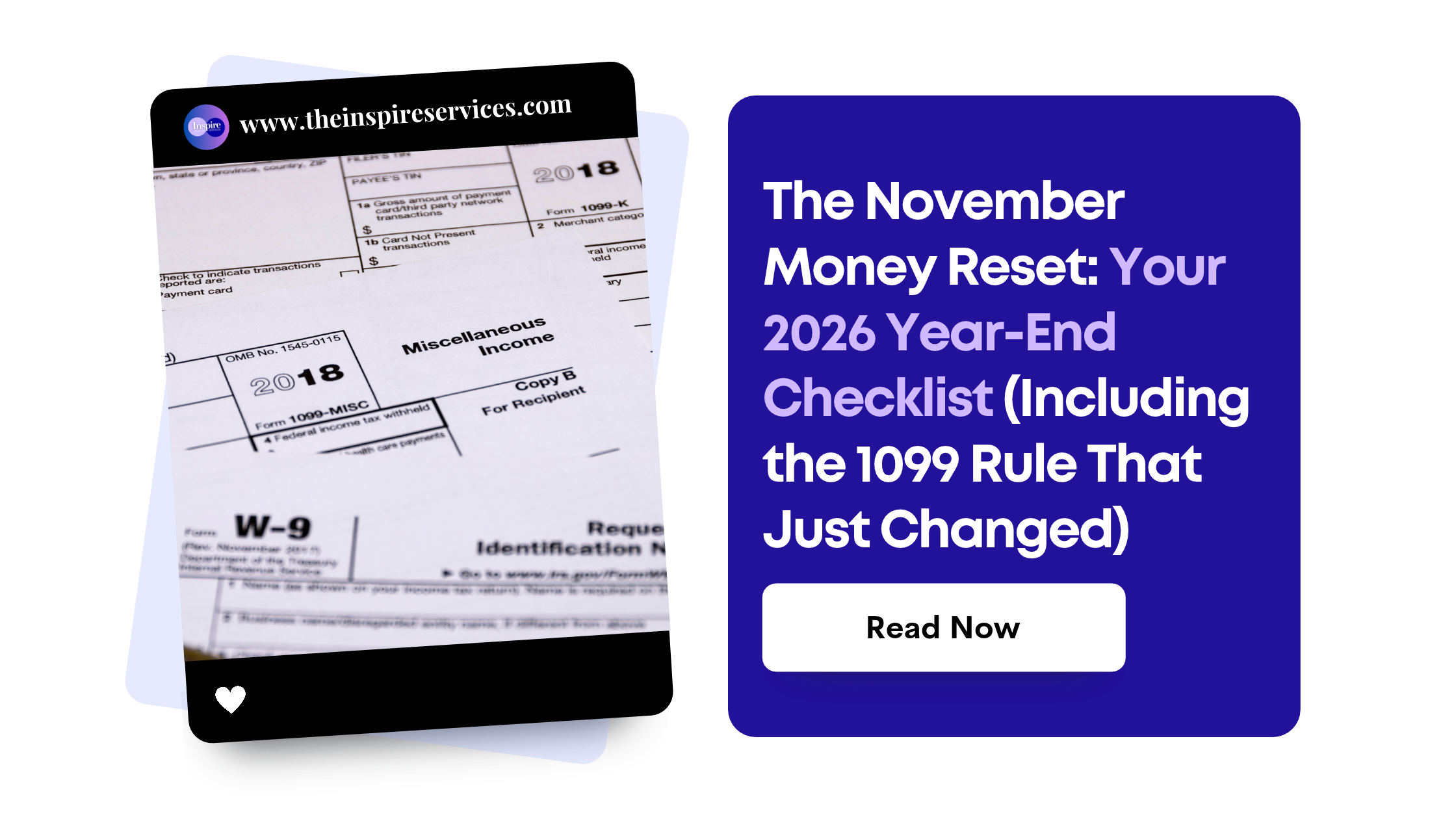
The 1099 rule changed this year, and most small business owners don't know it.
For more than 70 years, if you paid an independent contractor $600 or more in a year, you owed them a 1099. For payments made in 2026, that threshold is now $2,000. It is the first change since 1954, and it affects the forms you will file in just a few months.
That's why this post is about November, not December. By the time most owners think about year-end, the holidays have already eaten the time they needed to do it well.
Why Year-End Always Turns Into a December Scramble
The obvious question is "What do I need to do before the year ends?" The real question is "Why does it always feel like there is no time left to do it?"
Psychologists call it the planning fallacy. In a 1994 study, Roger Buehler and colleagues asked students to predict when they would finish their theses. On average, they predicted about 34 days. The actual average was about 55, and only about 30 percent finished by the date they predicted. Even when people know past projects ran late, they still picture the best-case version of the next one.
Year-end works the same way. You picture a calm December with a free afternoon to clean up the books. Then client rushes, holiday events, family travel, and the week between Christmas and New Year's, when nobody answers email. November is the last month that still behaves like a normal working month.
The 1099 Change, in Plain English
Here is what changed under the One Big Beautiful Bill Act, signed in July 2025:
🔹 The 1099-NEC and most 1099-MISC thresholds rose from $600 to $2,000 for payments made on or after January 1, 2026. Starting in 2027, that number will adjust for inflation each year.
🔹 The first forms under the new rule are filed in early 2027. The usual deadline is January 31, but because it falls on a Sunday in 2027, the deadline moves to the next business day, Monday, February 1.
🔹 The 1099-K threshold for payment apps went back to $20,000 and 200 transactions. That is the form platforms like PayPal, Venmo, and Stripe send.
🔹 Income is still taxable below the threshold. A contractor you paid $1,500 will not get a form from you, but they still owe tax on every dollar. And you still need records of every payment for your own deductions.
The non-obvious part: a higher threshold makes sloppy records more dangerous, not less. When fewer payments generate forms, your own books become the only record of what you paid and why. A contractor you paid $1,800 in March and $400 in December crosses the line, and you will only catch that if both payments are tracked in one place.
Sources: Patriot Software on the 2026 threshold, TaxBandits 2026 Form 1099-NEC guide. This is general information, not tax advice, so confirm your specific situation with your CPA.
Why Owners Avoid Their Numbers (And Why it Backfires)
If you have been putting off opening your books, you are not lazy. You are human.
Behavioral economists call it the ostrich effect. A 2009 study by Niklas Karlsson, George Loewenstein, and Duane Seppi found that investors checked their portfolios less often when the market was down. People avoid information they expect to be bad news, even when looking would help them act sooner.
Owners do the same thing with their books. The months that feel tight are exactly when they skip bookkeeping, so problems stay hidden until they get bigger and more expensive.
The fix is not more willpower. It is a decision made in advance. Research by psychologist Peter Gollwitzer on implementation intentions shows that "if-then" plans, like "When it is Friday at 2 pm, I reconcile last week's transactions," make people significantly more likely to follow through than goals alone. A recurring, specific time beats a vague intention.
Your November Money Reset Checklist
Reconcile every account through October. Bank, credit cards, and payment platforms. If November and December go sideways, you are only two months behind instead of ten.
Collect a W-9 from every contractor you paid this year. Do it now, while people are still answering email. Chasing tax IDs in late January, with a filing deadline days away, is a headache you can skip entirely.
Total your payments per contractor. Anyone who pays $2,000 or more in 2026 gets a 1099-NEC. Flag anyone close to the line who you may pay again before December 31.
Chase overdue invoices before the holidays. Many clients' accounting teams slow down in late December. An invoice that is 45 days late in November can easily become 90 days late by January.
Set aside your fourth-quarter estimated tax. If you make estimated payments, the Q4 payment for 2026 is due January 15, 2027, right after the holiday spending month.
Cancel the subscriptions you stopped using. Go through your card statements line by line. You'll often find a tool you forgot you were still paying for.
Book a year-end call with your CPA in November. Some tax-saving moves, like timing equipment purchases or retirement contributions, only work if they happen before December 31. Ask what applies to you.
Pick your recurring money hour for 2027. One specific day and time each week. Put it on the calendar now so January starts with a system, not a resolution.
How to Know it Worked
By November 30, you should be able to answer yes to four questions:
🔹 Are my books reconciled through October?
🔹 Do I have a W-9 for every contractor I paid?
🔹 Do I know exactly who gets a 1099-NEC this year?
🔹 Is my recurring money hour on the calendar?
Four yeses mean you walk into January with the hard part already done. Anything less tells you exactly where to spend the next two weeks.
You Do Not Have to Carry This Part Alone
At Inspire, we handle bookkeeping and invoicing as part of the operations work we run for business owners every week, from tracking contractor payments to chasing invoices nobody wants to send. The goal is simple: keep your numbers current, meet your deadlines, and make year-end less of a season you dread.
Not sure where your business stands? Take our free 2-minute audit at theinspireservices.com and see which parts of your operations to hand off first.
